

Beat the Nevada Heat: How the Right Low-E Glass Keeps Your Pahrump Home Cool
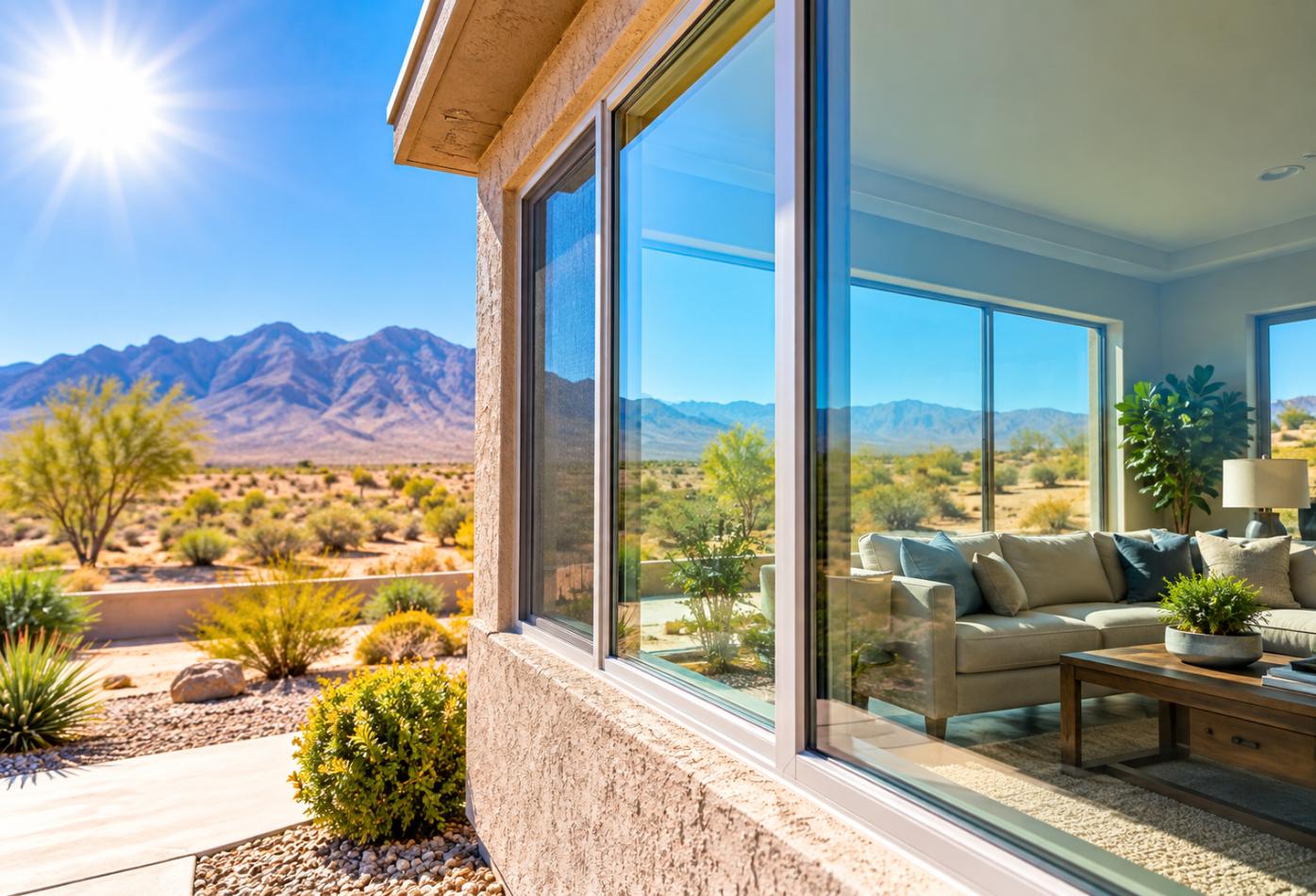
Summer sun in Pahrump can turn a bright living room into one of the hottest rooms in the house. Large west-facing windows, sliding glass doors, and other exposed glass can allow solar heat into the home just when the cooling system is already working hardest.
Quick answer: The right Low-E glass can help keep a Pahrump home cooler by reducing the amount of solar heat that passes through the glass while still allowing useful daylight inside. For Southern Nevada homes, choosing glass with an appropriate solar heat gain coefficient is especially important. Low-E glass cannot eliminate the need for air conditioning, but properly selected glazing can improve comfort and reduce unwanted heat gain through windows and doors.
What local homeowners should know
-
Low-E coatings are designed to manage radiant heat while maintaining visibility through the glass.
-
In the Pahrump Valley, lower solar heat gain can be especially useful on windows receiving intense afternoon sun.
-
Solar heat gain coefficient, or SHGC, tells you how much solar heat a window allows through, with lower numbers indicating less solar heat transmission.
-
Window orientation matters because west-facing glass can receive strong afternoon exposure when outdoor temperatures are already high.
-
Low-E glass works best as part of a complete window system that also addresses insulation, air leakage, frames, and proper installation.
Why Does Low-E Glass Matter in Pahrump?
Low-E glass matters in Pahrump because windows can become a significant path for unwanted solar heat during the long cooling season, and selecting glazing designed for a warm climate can reduce how much of that heat reaches the home’s interior.
The U.S. Department of Energy recommends low solar heat gain coefficients for warm climates because they reduce unwanted heat entering through windows. It also notes that Low-E coatings, particularly spectrally selective coatings, can reduce summer heat gain without significantly affecting visible light.
That guidance is particularly relevant in the open desert environment of the Pahrump Valley. Homes around Nye County may have relatively little natural shade, and properties with broad views toward the Spring Mountains can also have substantial areas of exposed glass.
Pahrump Valley Glass helps local property owners evaluate glass and window needs for these desert conditions. From here, we focus on matching the glass to the opening, exposure, and goals of the property rather than assuming every window needs exactly the same solution.
What Does Local Energy Guidance Tell Homeowners?
Local and federal energy guidance shows that window performance should be matched to climate, with solar heat gain becoming especially important where cooling is a major concern.
The U.S. Department of Energy identifies SHGC and U-factor as two primary measures homeowners should consider. SHGC describes how much solar heat passes through a window, while U-factor measures heat transfer through the complete window system. Lower values generally mean less solar heat transmission and lower heat transfer, respectively.
Valley Electric Association serves the local area from its Highway 372 location, making electricity use a familiar household concern for area residents. Reducing unnecessary heat gain through exposed glass can help address one part of a home’s overall cooling load, although actual energy results vary by the home, glass area, orientation, HVAC system, insulation, and occupant habits.
How Can the Right Low-E Glass Affect Indoor Comfort?
The right Low-E glass can improve indoor comfort by limiting radiant solar heat entering through windows, particularly in rooms that become noticeably warmer when direct sunlight reaches the glass.
Think about a west-facing family room near State Route 160 on a summer afternoon. Even when the air conditioner maintains the thermostat setting, someone sitting beside an untreated or poorly performing window may still feel uncomfortable because of radiant heat.
Reducing solar heat transmission can help make temperatures near the glass feel more manageable. It can also help address rooms that consistently become hotter than the rest of the house during sunny periods.
Low-E glass is not a cure for every hot room. Attic insulation, ductwork, air leaks, shading, HVAC performance, and building orientation can all affect comfort.
What Are the Signs Your Current Glass May Be Contributing to Heat Gain?
Glass may be contributing to indoor heat problems when sunny rooms become noticeably hotter, uncomfortable areas develop near windows, or cooling demands appear to increase during periods of direct solar exposure.
Watch for these common signs:
-
Rooms with west-facing windows become significantly less comfortable in the afternoon.
-
Furniture or flooring near windows feels unusually warm in direct sunlight.
-
You avoid sitting near certain windows during summer afternoons.
-
Blinds or curtains need to remain closed throughout the day simply to control heat.
-
Large glass doors create noticeable hot zones near the opening.
-
Older windows appear to perform differently from newer windows elsewhere in the home.
-
Your cooling system maintains temperature, but rooms with extensive glass still feel uncomfortable.
These symptoms do not automatically mean the glass needs replacement. A professional evaluation can help separate glazing issues from air leakage, frame problems, failed insulated units, or other building-envelope concerns.
When Should You Call a Glass Professional?
You should call a glass professional when heat problems are concentrated around particular windows or doors, the existing glass is damaged or failing, or you want to determine which glazing specifications make sense before replacing glass or windows.
Homeowners can safely observe which rooms receive direct sun and when those rooms become uncomfortable. You can also note window orientation and compare sunny rooms with shaded rooms.
Professional help becomes useful when you need to identify existing glass, evaluate replacement options, measure an opening, or determine whether the glass alone or the complete window assembly needs attention.
What Common Local Conditions Increase Window Heat Gain?
The most common local contributors to window heat gain are strong solar exposure, limited exterior shade, large areas of glass, and window orientations that receive direct afternoon sun.
In the Pahrump Valley, these conditions can occur together. A single-story desert home on an open lot may receive considerably more direct exposure than a home shaded by mature landscaping or neighboring structures.
West-facing windows are often worth examining first because afternoon sunlight arrives during an already hot portion of the day. South-facing glazing can also receive substantial solar exposure depending on the season, roof overhangs, landscaping, and window placement.
Large patio doors and picture windows deserve attention as well because their greater glass area can make solar performance more noticeable.
How Can Homeowners Reduce Solar Heat Gain?
Homeowners can reduce solar heat gain by combining suitable Low-E glass with exterior shade, effective window coverings, good seals, and sensible maintenance of the complete window assembly.
Start by identifying the windows that receive the most direct sun. Exterior overhangs and shading can help where appropriate, while interior blinds and shades provide another layer of control. The Department of Energy also identifies exterior shading and interior window coverings as methods for reducing unwanted solar heat.
Check weatherstripping and seals periodically, especially after dusty or windy desert conditions. If you see cracked glass, condensation trapped between panes, damaged frames, or failed seals, move beyond DIY inspection and have the assembly evaluated.
What Results Can You Expect From Low-E Glass?
Properly selected Low-E glass can reduce unwanted solar heat transmission and improve comfort near exposed windows, but the exact improvement depends on the existing glass, orientation, window size, shading, and overall efficiency of the home.
A homeowner replacing older clear glass may notice that direct sun feels less intense through the upgraded glazing. Rooms with substantial exposed glass may also become easier to keep comfortable.
Energy savings should not be promised as a fixed percentage. Windows are only one part of the home’s thermal envelope, and insulation, HVAC efficiency, air sealing, thermostat settings, and household behavior all affect electricity use.
What Mistakes Should Pahrump Homeowners Avoid?
The biggest mistakes are choosing glass based only on appearance, assuming all Low-E coatings perform the same way, and ignoring the orientation and condition of the complete window.
Mistake: Choosing only by tint or darkness.
Consequence: Darker-looking glass does not automatically provide the right overall performance.
Better approach: Compare relevant performance ratings, including SHGC.
Mistake: Treating every side of the house identically.
Consequence: A shaded opening and a west-facing picture window may have very different solar exposure.
Better approach: Consider orientation, window size, and existing shade.
Mistake: Assuming new glass fixes every hot room.
Consequence: The actual problem may include air leakage, insulation, ductwork, or HVAC performance.
Better approach: Evaluate the symptoms before deciding on a solution.
What Is a Common Local Low-E Glass Scenario?
A common local scenario is a Pahrump home with a large west-facing living-room window that becomes uncomfortable every summer afternoon even while the rest of the house remains reasonably cool.
The homeowner may initially rely on closed blinds throughout the afternoon. When evaluating a longer-term solution, the important questions include the condition of the existing window, the amount of direct solar exposure, the size of the opening, and the performance characteristics of possible replacement glass.
This is a representative scenario, not a specific customer case study. The appropriate solution depends on an inspection of the actual opening.
Which Glass Services Can Help?
Glass replacement and window-related services can help when existing glazing is damaged, poorly suited to the home’s solar exposure, or ready for an efficiency-focused upgrade.
We can help homeowners evaluate glass options for windows and other residential openings while considering the realities of desert heat and sun exposure. The goal is to select a practical solution for the specific property rather than recommending an upgrade the home does not need.
How Do Low-E Glass Options Compare?
Low-E options should be compared by actual performance characteristics rather than by the Low-E label alone, with SHGC, U-factor, visible light, orientation, and the complete window assembly all contributing to the decision.
Standard clear glass may provide daylight and visibility but offers less control over solar heat than glazing designed specifically to manage heat transfer. Low-E coatings add a microscopically thin layer designed to influence radiant heat transmission.
For a warm desert environment, lower solar heat gain is generally desirable. The Department of Energy specifically recommends low-SHGC products for warm climates and explains that lower SHGC values indicate less solar heat transmission.
The best choice still depends on the opening. Extremely low solar gain is not automatically the right answer for every window, especially when daylight, appearance, orientation, and other design goals matter.
Where Do We Help Local Property Owners?
We help property owners in Pahrump and the surrounding Pahrump Valley evaluate residential glass needs with local desert conditions in mind.
Properties across Nye County, including homes toward the edges of town and routes leading toward communities such as Amargosa Valley, can experience significant sun exposure. Local conditions should remain part of the conversation whenever glass is being selected for comfort or efficiency.
What Can Happen If You Ignore Excessive Window Heat Gain?
Ignoring excessive window heat gain can leave rooms uncomfortable and place unnecessary cooling demands on the home, particularly when large exposed windows repeatedly admit afternoon solar heat.
The issue does not always require immediate glass replacement. However, repeatedly closing off a room or running the cooling system harder without identifying the source can leave the underlying comfort problem unresolved.
A glass evaluation can help determine whether an upgrade makes sense or whether another part of the home should be investigated first.
FAQ About Low-E Glass in Pahrump
Is Low-E glass worth considering for a Pahrump home?
Yes. Low-E glass is particularly relevant in a hot, sunny environment because suitable coatings can reduce unwanted solar heat entering through windows. The benefit will vary with orientation, window area, shading, existing glazing, and the rest of the home’s building envelope.
What SHGC is best for windows in Pahrump?
A lower SHGC is generally preferred in warm climates because it indicates less solar heat transmission. The U.S. Department of Energy recommends low solar heat gain products for warm climates. The appropriate specification for an individual home should consider the complete window, orientation, daylight preferences, and applicable requirements.
Does Low-E glass make a Pahrump house darker?
Not necessarily. Low-E coatings can reduce solar heat while still allowing substantial visible light through the window. Visible transmittance is a separate performance measurement from SHGC, so homeowners can compare both when balancing daylight with solar heat control.
Should west-facing windows use Low-E glass?
West-facing windows are strong candidates for solar-control glazing because they can receive direct afternoon sunlight during a hot part of the day. In the Pahrump Valley, homeowners experiencing afternoon hot spots near western windows should consider orientation when comparing replacement glass.
Can Low-E glass lower my electric bill?
It can help reduce unwanted heat gain through windows, which may reduce part of the home’s cooling load, but a specific bill reduction cannot be guaranteed. Valley Electric Association bills local electricity use, while actual household consumption also depends on HVAC efficiency, insulation, air sealing, thermostat settings, home size, and occupant behavior.
Does Low-E glass block all Nevada heat?
No. Low-E glass reduces particular forms of heat transfer, but it does not stop all heat from entering a building. Walls, roofs, doors, air leaks, and other windows also affect indoor temperatures. Effective desert-home comfort usually requires several parts of the building envelope to work together.
Can I add Low-E glass without replacing every window?
Possibly. Whether individual glass units can be addressed depends on the construction and condition of the existing windows. A professional should inspect the opening and determine what replacement options are practical before assuming the entire house needs new windows.
How do I know whether my glass or HVAC system is causing a hot room?
Start by noticing whether discomfort is strongest near windows and closely follows direct sunlight. If the entire home struggles to maintain temperature, HVAC or insulation issues may also be involved. A room that becomes hot primarily during direct solar exposure provides a reason to evaluate its windows and shading.
Make Your Home More Comfortable in the Desert Heat
Living in Pahrump means designing and maintaining a home for intense sunshine, not simply reacting when a room becomes uncomfortable. Choosing the right Low-E glass can help control unwanted solar heat while preserving the daylight and views that make windows valuable in the first place.
We can help you evaluate your existing glass and determine which options fit your home’s exposure and comfort goals.